News & Media




2026/03/17
260
Ⅰ. Equipment Description
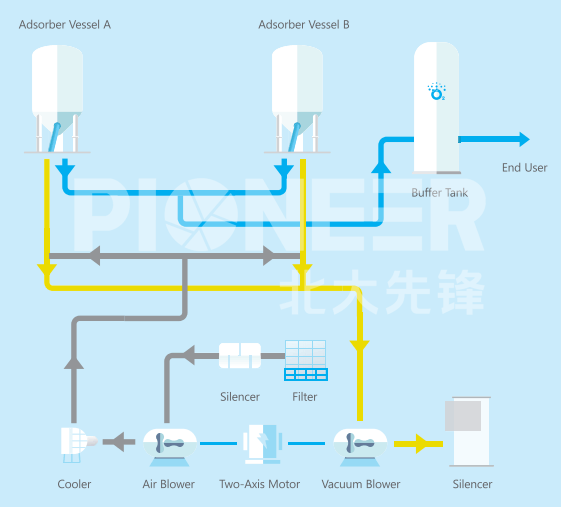
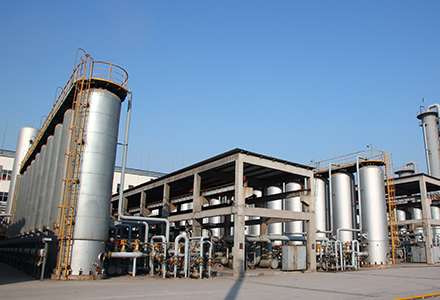
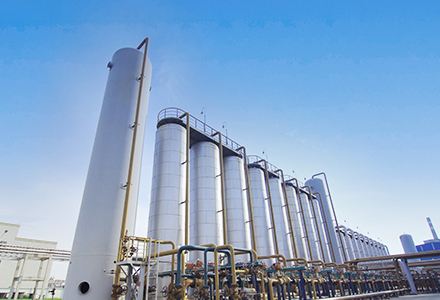
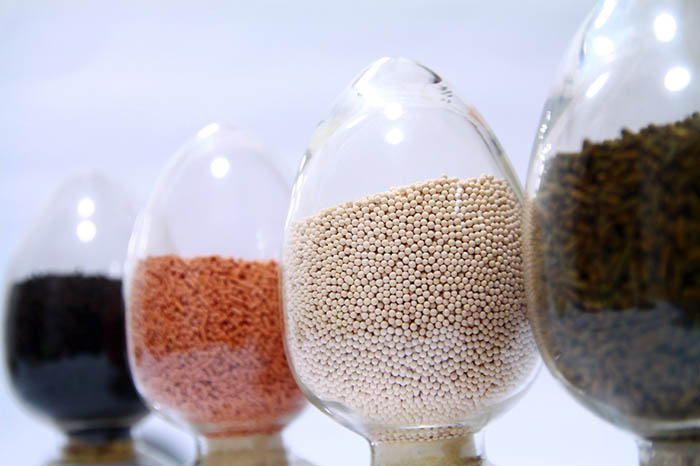
Basic principle of pressure swing adsorption (PSA) oxygen production: Raw air is filtered to remove impurities through the blower inlet filter before entering the blower. After being pressurized by the blower, it enters the adsorbent bed via pipelines and pneumatic switching valves. Moisture and carbon dioxide in the raw air are adsorbed by PU-8/TS adsorbent. During the process where the purified air passes through the PU-8 oxygen-producing adsorbent in the adsorber, nitrogen is gradually adsorbed, resulting in the enrichment of oxygen at the top of the adsorber. The product oxygen flows out from the top of the adsorber, enters the oxygen buffer tank, and is supplied to users after being pressurized.
To continuously obtain oxygen, generally two or more adsorbers are installed. One adsorber adsorbs nitrogen from the air under high pressure, and product oxygen is obtained from the outlet of the adsorber; other adsorbers undergo desorption or pressure boosting under low pressure to adsorb nitrogen from the raw air in the next cycle. Several adsorbers switch alternately to achieve continuous oxygen production.
The instrument control system adopts the advanced German Siemens PT-1500 system, whose advanced management control and data acquisition system provides users with flexible and powerful functions to monitor the production process.
Ⅱ.Overview
1 Key Indicators
2 Operating Conditions
|
Product Name |
Designed Output (Nm³/h) |
Purity |
Pressure Before Boundary Valve(KPa (G)) |
Remarks |
|
Oxygen-Enriched Air |
25,000 |
80% |
15 |
|
Notes:
(1)Nm³/h refers to the volume measured at 0℃ and 101.3 KP(A) (the same below);
(2)Start-up time: 20 minutes (30 min for initial start-up) until the oxygen product meets the purity index; specific energy consumption for oxygen production (based on air compressor shaft power ±4%): ~0.305 kWh/Nm³ O₂
3.Basic Principle
Basic principle of vacuum pressure swing adsorption (VPSA) oxygen production: Raw air is filtered to remove impurities through the blower inlet filter before entering the blower. After being pressurized by the blower, it enters the adsorbent bed via pipelines and pneumatic switching valves. Moisture and carbon dioxide in the raw air are adsorbed by the PU-8/TS adsorbent. During the process where the purified air passes through the PU-8 oxygen-producing adsorbent in the adsorber, nitrogen is gradually adsorbed, resulting in the enrichment of oxygen at the top of the adsorber. The product oxygen flows out from the top of the adsorber, enters the oxygen buffer tank, and is supplied to users after being pressurized.
4.Overview of Process Flow
4.1 Oxygen Production
For the VPSA (Vacuum Pressure Swing Adsorption) oxygen production process, each cycle must complete steps such as adsorption, cocurrent depressurization, vacuum desorption, purging, pressure equalization, and pressure boosting.
Adsorption: Air passes through the adsorber bed, where nitrogen is adsorbed. Once the adsorber reaches a certain pressure, the product oxygen flows into the oxygen buffer tank.
Cocurrent Depressurization: After adsorption is completed, the gas at the adsorber outlet has a relatively high oxygen content. This part of the gas is depressurized cocurrently and released into the low-pressure adsorber.
Vacuum Desorption: After cocurrent depressurization, the adsorber pressure is still relatively high. A vacuum pump is used to further reduce the pressure inside the adsorber, and the desorbed nitrogen is extracted and vented to the atmosphere.
Purging: Before the adsorber reaches the minimum desorption pressure during vacuum pumping, oxygen is introduced into the adsorber from the outlet while vacuum pumping continues at the bottom of the adsorber, facilitating further desorption of the adsorbed nitrogen.
Pressure Equalization: After the adsorber is regenerated, the gas from the adsorber that has completed adsorption is introduced into the regenerated adsorber from the outlet, while vacuum pumping continues at the bottom of the regenerated adsorber.
Pressure Boosting: After pressure equalization, the adsorber pressure is still low. Product oxygen from the oxygen buffer tank enters the adsorber from the outlet, and air is introduced from the bottom of the adsorber to boost its pressure.
The cyclic operation of the above steps enables the separation of oxygen and nitrogen from air, thereby obtaining product oxygen that meets the required specifications. The switching between each operational step is achieved by pneumatic switching valves, which automatically open and close according to the settings of the control system program.
4.2 VPSA Process Flow Schematic Diagram